
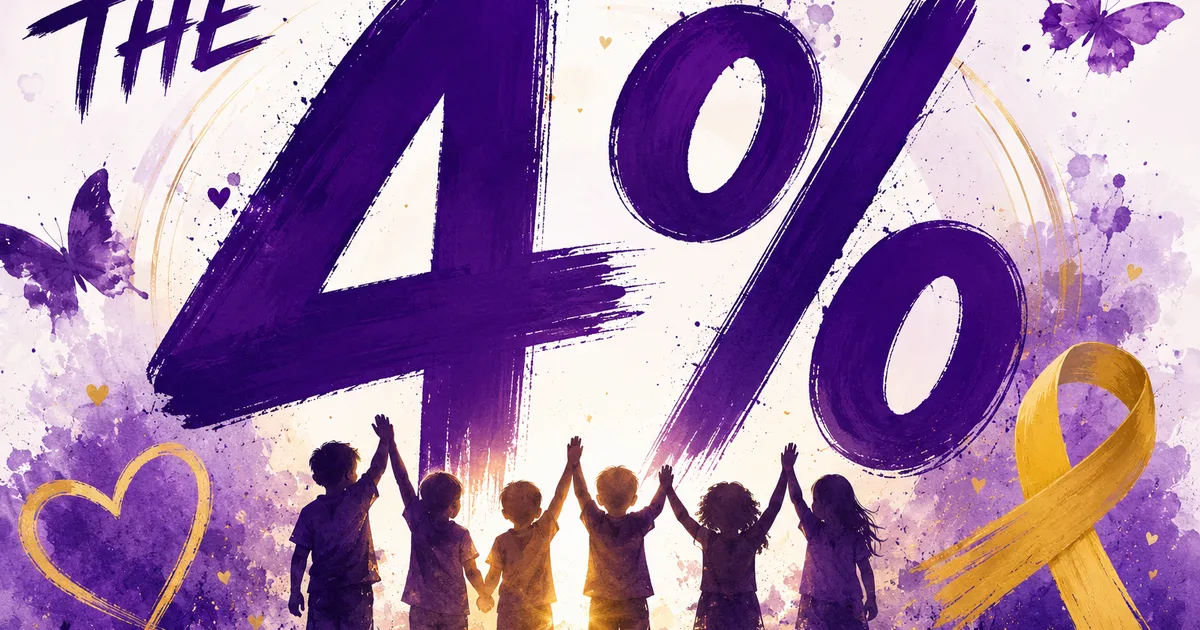
THE 4%
The number I never thought I would care about.
I want to talk about a number.
4%.
Before my daughter got cancer, I probably would have heard that number, thought it was concerning, felt bad for the families affected by childhood cancer, and then continued with my day.
Not because I didn't care.
I did.
I'd heard about cancer. I'd seen children fighting it. I'd seen families raising money and organizations asking for support.
But if I'm being honest, I didn't understand it.
I didn't understand what childhood cancer actually does to a family.
I didn't understand what it feels like to sit in a hospital room and realize that your entire world has suddenly become about your child.
I didn't understand the fear.
The exhaustion.
The uncertainty.
Or the questions that never seem to stop.
Will this treatment work?
What happens if it doesn't?
Is there another option?
Will my child get the chance to grow up?
Then my daughter got cancer.
And suddenly, numbers weren't numbers anymore.
They became personal.
So what is the 4%?
According to St. Jude Children's Research Hospital, federal funding for childhood cancer research accounts for about 4% of the National Cancer Institute's budget. St. Jude
Four percent.
When you hear that number by itself, you might not think much of it.
But think about what that number represents.
St. Jude says that more than 290 children and adolescents in the United States are diagnosed with cancer every week. St. Jude
That's more than 40 children every day.
While most of us are waking up, going to work, taking our kids to school, making dinner, paying bills, and worrying about the ordinary problems of everyday life, another family is hearing words that can change their entire world:
"Your child has cancer."
And I was one of those people who didn't fully understand what that meant.
Until I did.
These aren't numbers. They're children.
Childhood cancer isn't one disease.
Children can develop cancers that are biologically different from cancers in adults, which is why pediatric-specific research matters. St. Jude
And research isn't some abstract thing happening in a laboratory far away from families.
Research can mean:
- A new treatment.
- A clinical trial.
- A better understanding of a cancer.
- A treatment that causes fewer long-term problems.
- Another option when the first treatment doesn't work.
- And sometimes, hopefully, a cure.
We've already seen what research can accomplish.
St. Jude reports that when it began its leukemia treatment studies in the 1960s, childhood acute lymphoblastic leukemia was generally considered fatal. Over time, advances in treatment helped raise survival for ALL dramatically; St. Jude now reports a 94% survival rate for children with ALL. St. Jude
That's what research can do.
It can change what parents are told is possible.
So why wouldn't we want more of it?
This is where I started asking questions.
I started looking beyond the number.
I started looking at how we, as a country, decide what deserves investment.
The Department of Defense's FY2026 budget request totaled $961 billion, according to the Congressional Budget Office. CBO described it as one of the largest defense requests of the past 50 years. Congressional Budget Office
And yes, the Department of Defense also funds medical research.
For FY2026, Congress appropriated $165 million for the Peer-Reviewed Cancer Research Program. Pediatric, adolescent, and young-adult cancers are among the eligible research areas. Congress.gov
I'm not saying we don't need a strong military.
I'm not saying our soldiers don't deserve support.
I'm not saying we can simply take money from the defense budget and move it somewhere else. Federal money doesn't work that way, and different programs have different purposes and legal restrictions.
That's not my argument.
My question is much simpler.
If we can find hundreds of billions of dollars for the things we decide are national priorities...
Can we decide that children with cancer are a national priority too?
Because even a tiny fraction of a $961 billion budget represents hundreds of millions of dollars.
For perspective:
0.01% of $961 billion is about $96 million.
0.1% is about $961 million.
Those are mathematical comparisons, not proposals to transfer defense funding.
But they make me stop and think.
What could we accomplish if we decided that finding better treatments for children deserved more?
Because children don't have time to wait.
A research project that doesn't receive funding doesn't simply sit there waiting for someone to come back to it.
A clinical trial can be delayed.
A promising idea can take longer to develop.
Researchers can struggle to get the resources they need.
And meanwhile, children are still being diagnosed.
Families are still sitting in hospitals.
Parents are still waiting for lab results.
Children are still going through chemotherapy, radiation, procedures, transfusions and everything else that comes with treatment.
Childhood doesn't wait.
A child doesn't get to say:
"That's okay. We'll try again in ten years."
And then I think about the people fighting this every day.
I think about the parents who start foundations after their own children are diagnosed.
I think about the parents who turn unimaginable pain into advocacy.
I think about survivors who become advocates.
I think about researchers who spend their careers searching for better answers.
I think about organizations raising money because they know how badly research is needed.
And I think about organizations traveling to Washington, D.C., to make sure childhood cancer isn't forgotten.
CureFest 2026, for example, is scheduled for September 18–20 in Washington, D.C., bringing together families, survivors, advocates and organizations for awareness and advocacy. Its schedule includes a rally to the Capitol and other events focused on the childhood-cancer community. CureFest
There are so many people fighting this fight.
Parents.
Doctors.
Researchers.
Survivors.
Foundations.
Advocates.
And now I understand why.
Because once you've lived this, you can't unknow it.
I used to be one of the people who didn't know.
And I don't say that with shame.
I say it because I think there are millions of people just like me.
People who care.
People who would help.
People who would want better treatments.
But people who simply don't understand the size of the problem because childhood cancer hasn't entered their home.
We all have our own problems.
Bills.
Jobs.
Families.
Stress.
Things we're trying to figure out.
That's life.
And when you're living your normal life, it's easy to think of childhood cancer as something terrible that happens somewhere else.
I used to think that way too.
Until it became my reality.
Now, when another parent tells me about their child, I hear it differently.
I understand the fear behind the words.
I understand why parents celebrate things other people might not understand.
I understand why a good lab result can feel like winning the lottery.
I understand why parents become advocates.
And I understand why research matters.
Because when your child is sick, you don't want someone to tell you:
"We've done everything we can."
You want them to say:
"We have another option."
And that's what the 4% means to me now.
It doesn't mean that 4% is the only money being spent on childhood cancer.
It doesn't mean researchers aren't doing incredible work.
It doesn't mean progress hasn't been made.
And it certainly doesn't mean that every problem would disappear if funding increased.
But it does tell us something important:
There is a gap.
And if there is a gap, we should be willing to talk about it.
We should be willing to ask whether we're doing enough.
We should be willing to ask our leaders for more.
We should be willing to support organizations doing the research.
We should be willing to support families doing the advocacy.
And we should be willing to talk about childhood cancer even when September is over.
Because you shouldn't have to wait until it's your child.
That is probably the biggest thing I've learned.
Before my daughter got cancer, I didn't realize how much I didn't know.
I didn't realize how many organizations were fighting.
I didn't realize how many different childhood cancers there were.
I didn't realize how much research mattered.
I didn't realize how quickly a child's diagnosis could turn an entire family's life upside down.
Now I do.
And I don't want people to learn the way I did.
I don't want people to have to sit in a hospital room before they understand why research matters.
I don't want another parent to have to hear the words "your child has cancer" before they start caring about what happens next.
You can care now.
You can learn now.
You can speak up now.
You can support research now.
You can share someone's story now.
Four percent is a number.
My daughter is not a number.
Jaden is not a number.
Davy is not a number.
The children fighting cancer today are not numbers.
The children we've lost are not numbers.
They're children who wanted to grow up.
They're kids who wanted to play sports, play video games, go to school, travel, make friends, fall in love, get jobs, have families and experience all the ordinary things we sometimes take for granted.
They're parents who want to watch their children grow up.
They're siblings who want their brothers and sisters home.
They're families who want their lives back.
And they're researchers who need the resources to find better answers.
So maybe we shouldn't just ask:
"Why is it 4%?"
Maybe we should ask:
"Why isn't it more?"
Because if we have the ability to do more...
we should.
For the children who are fighting today.
For the families who are fighting beside them.
For the children we've lost.
And for the children who will be diagnosed tomorrow.
They deserve more than 4%.
They deserve our best.
They deserve our attention.
They deserve our investment.
They deserve a chance.
And that's why I'm talking about the 4%.
Not because I knew about it before.
I didn't.
I know about it now.
And I can't look away anymore.
Discussion (1)
Please login to join the discussion
Yo,como abuelo de una hermosa guerrera sobreviviente de cancer,al leer las conmovedoras y amargas experiencias de los padres que han vivido ó están viviendo esta terrible enfermedad al lado de un pequeño niño,me conmueven hasta las lagrimas,pero,me inspira,me motiva y me ayuda a comprender,la necesidad que hay en apoyar a esas fundaciones que se preocupan por buscar ayuda para todas esos niños que no deberían de estar sufriendo de esa manera.