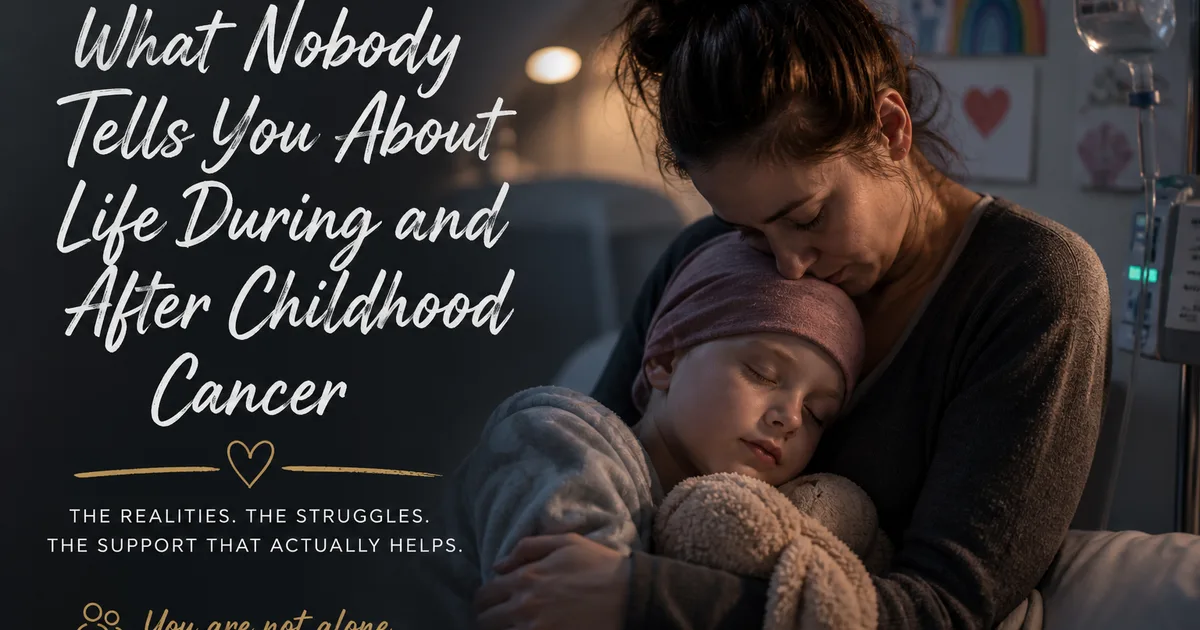
What Nobody Tells You About Life During and After Childhood Cancer
When a child is diagnosed with cancer, everyone around you goes into action mode. Meals show up. Messages pour in. People say "let me know if you need anything." And then slowly, quietly, life around you goes back to normal. Except yours doesn't.
This article is for the parents who are living that reality right now. The ones who are tired but can't explain why to someone who hasn't been there. We found some graphics from @CancerGhosted that put into words what so many families feel but struggle to say out loud. We wanted to take those words and go deeper.
Graphics referenced in this article are by @CancerGhosted. All credit to them for putting these feelings into words.
Cancer Changes the Way You Think. Permanently.
There is a version of you that existed before diagnosis day. That person is gone. Not in a dramatic way, not in a way you can fully explain at a dinner table, but gone.
"I don't chase connection anymore. I pay attention to who actually shows up."
That line hits differently when you have spent nights in a hospital room counting exactly who texted, who called, and who just disappeared. You stop spending energy on people who don't show up when it counts. It's not bitterness. It's clarity.
"My tolerance for nonsense is gone."
Small talk feels impossible when your brain has been running on crisis mode for months. While other people stress about things that used to matter to you, you're sitting there thinking about port access and lab results and whether that cough means something. Your priorities shifted in a way that can't be undone.
"There's a whole world of people quietly going through it and you'd never know just by looking."
Every cancer parent knows the feeling of sitting in that parking lot, watching strangers walk in and out of the cancer center, and realizing that every single one of them is carrying something enormous. It changes how you see people. All people. Forever.
What Cancer Does to Your Finances That Nobody Prepares You For
People think about the medical bills. What they don't think about is everything else.
"Income suddenly drops or disappears. You can't work the same hours, or at all."
One parent is often at the hospital. The other is trying to hold down a job, manage the house, take care of siblings, and not fall apart. Something has to give. Usually it's income.
"Bills don't stop just because you're sick. Basic things start feeling expensive."
Rent doesn't pause. Car payments don't pause. Groceries don't pause. And now you're adding travel costs, parking fees, medications insurance won't cover, and a thousand small expenses that add up to something crushing.
"Financial stress doesn't end when treatment does. It will take years to rebuild."
This is the part that surprises people most. Treatment ends and everyone assumes the hard part is over. But the debt is still there. The lost savings are still gone. The career interruption is still real. Families are rebuilding for years after the bell rings, quietly, without anyone asking how they're doing financially anymore.
If you are struggling financially right now, please know you are not alone in this either. Visit our resource directory and filter by financial assistance to find grants, emergency funds, and support programs near you.
What People Think Helps vs. What Actually Does
This one is hard to talk about because nobody means to get it wrong. People love you. They just don't know what to do.
"Saying let me know if you need anything puts more pressure on us. We're already overwhelmed."
When you are in survival mode, figuring out what to ask for and then asking for it takes energy you don't have. The families who felt most supported were the ones where someone just did something without asking. Dropped off dinner. Picked up a sibling from school. Sent a gift card with a note that said no response needed.
"Checking in once and disappearing feels good at first, then we're left alone again."
The first week of a diagnosis, support floods in. By month three, most people have moved on. But the family hasn't. They're still there, still fighting, still exhausted. Showing up consistently matters so much more than showing up once.
"Sit with us without needing to fix anything. Be present. Listen. Let us be real."
You don't need to have the right words. Most of the time there are no right words. What helps is someone who can sit in the hard without trying to make it prettier than it is. Someone who doesn't flinch when you say you're not okay.
If you are a friend or family member of a childhood cancer family reading this, that's what we need from you. Not perfect. Just real and consistent.
You Are Not Alone In This
These flyers went around cancer support groups for a reason. Because they say what families feel but can't always find the words for. If any of this resonated with you, share it with someone in your life who needs to understand what you're going through.
Discussion (0)
Please login to join the discussion
No comments yet. Be the first to share your thoughts!